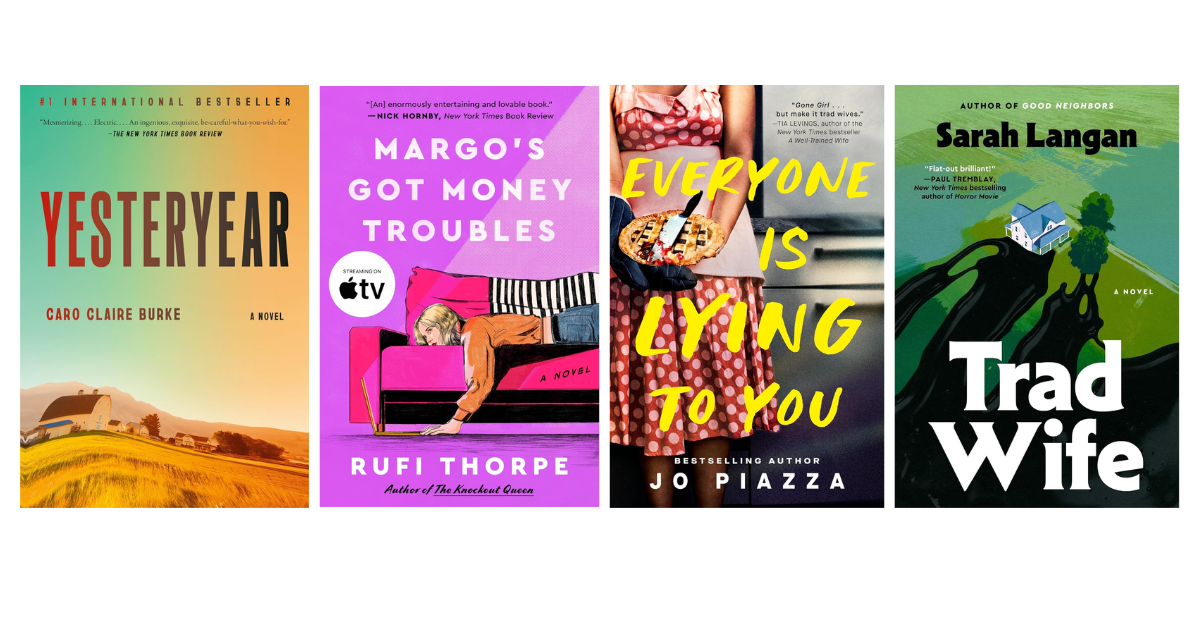
So you may have heard of a little book called YESTERYEAR by Caro Claire Burke. Or rather, I would be surprised if you were a person who liked books and/or was on the internet and hadn’t heard about YESTERYEAR: the rapturous praise and media attention, the forthcoming movie adaptation starring Anne Hathaway, the TikTok rants and raves, the predicable backlash. But above all — the conversation. I can’t remember the last time I read a book that I was compelled to talk to other readers about, to share our responses and nitpick the author’s choices. In case you’ve been living under a rock, here’s the publisher’s description:
A traditional American woman, a beautiful wife and mother who sells her pioneer lifestyle of raw milk and farm-fresh eggs to her millions of social media followers, suddenly awakens cold, filthy, and terrified in the brutal reality of 1855—where she must unravel whether this living nightmare is an elaborate hoax, a twisted reality show, or something far more sinister in this sensational debut novel.
Some of you may have already been subjected to my conversations about the comparisons in attention and acclaim between YESTERYEAR and MARGO’S GOT MONEY TROUBLES by Rufi Thorpe. As per my Instagram story from earlier this year:
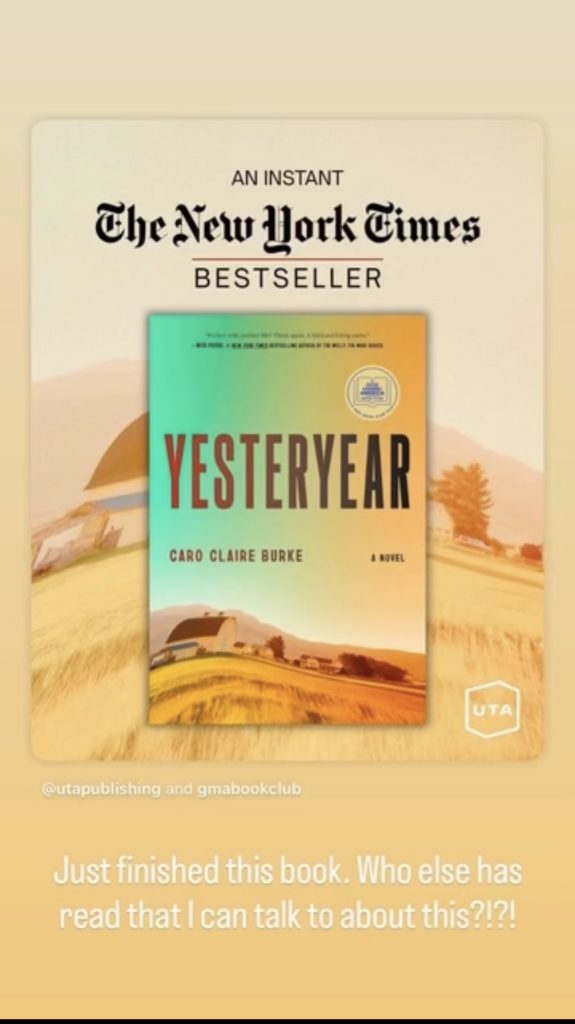
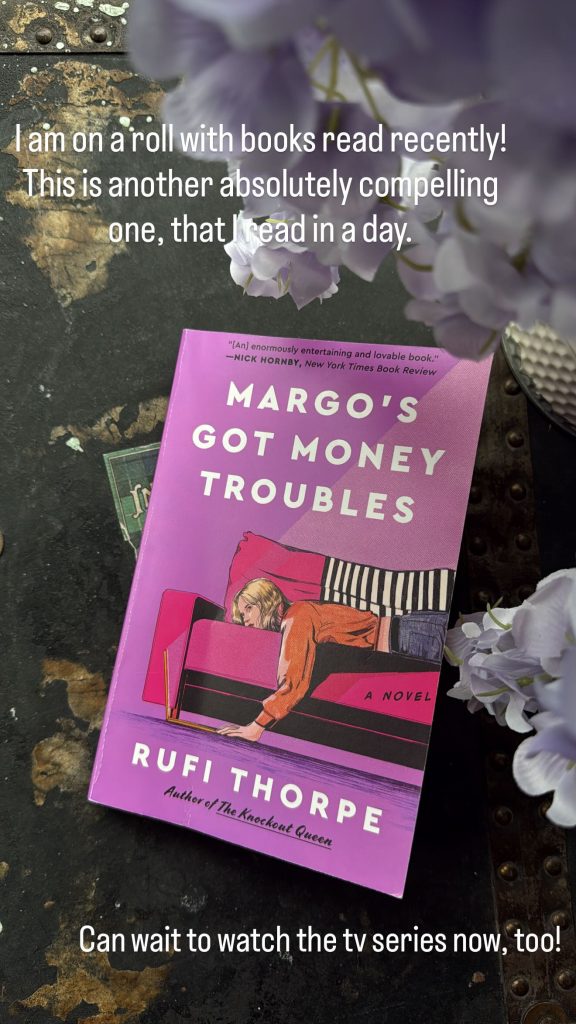
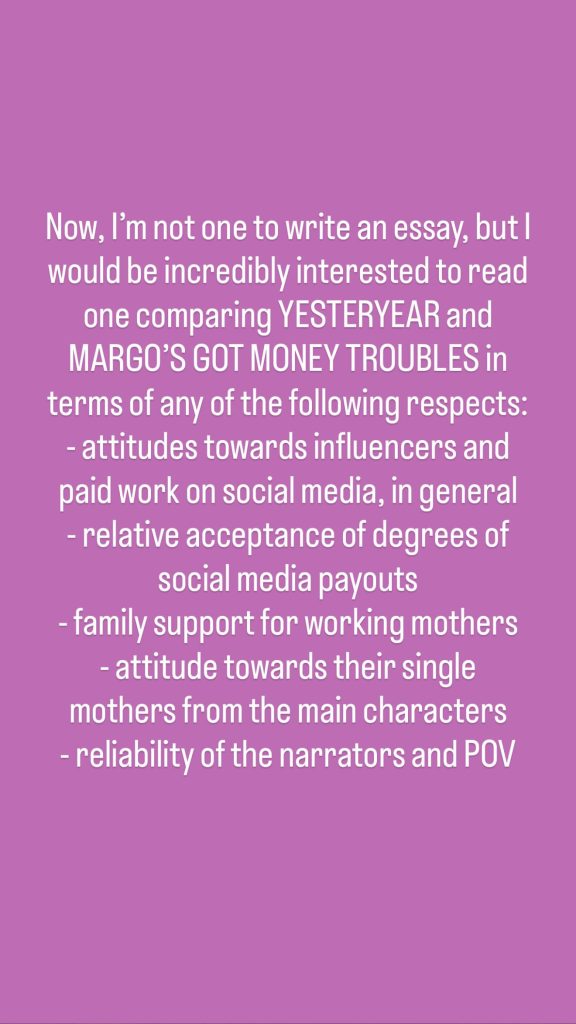
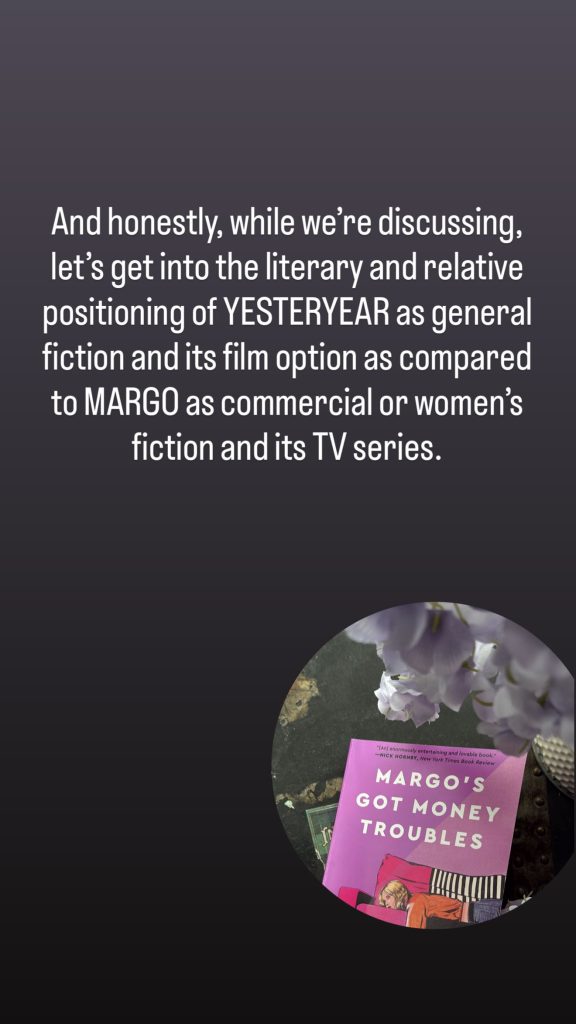
To expand on it even further:
-both books show a woman caring for and providing for her family via paid work on social media, although Natalie’s work as an influencer is more traditionally coded and socially acceptable than Margo’s work on Only Fans. Yet both are selling a version of themselves to their followers — is Margo or Natalie more honest? How do the responses to their payouts differ? Margo’s income goes directly to taking care of rent and food and supplies for her baby, while Natalie is shown to be secreting a portion of her income away from her husband.
-Both MCs are raised by single mothers whose relationship with the church changes over the course of the novel. In YESTERYEAR’s case, Natalie’s mom becomes more open, and hopes that Natalie would be kinder, while Margo’s mom becomes more rigid and traditionally puritanical, while also being more two-faced about her own foibles.
-And both stories speak explicitly about the reliability of their narrators – Natalie is eventually revealed to have had a total psychotic break that has kept her from remembering that she did this to herself, while Margo’s story alternates between 3rd person omniscient and close 1st person POV depending on how much of the story she wants to reveal to the reader.
-And finally, I find it incredibly interesting, as a publishing professional, to see the comparative marketing of the two books. YESTERYEAR is firmly positioned as literary fiction (or general book club fiction at it’s most highbrow/commercial), and has a film option from Anne Hathaway. MARGO’s pink and purple cover and marketing positions it as women’s fiction for a commercial or romance reader, and got a TV series. What is that saying about the relative merits of happy endings for the main female characters in each book?
Last year around this time, a friend recommended the thriller EVERYONE IS LYING TO YOU by Jo Piazza, which I devoured on a beach in Florida on vacation. This novel also features a tradwife influencer, but through the lens of a mystery about her disappearance and a possible murder, from an outsider’s perspective. What does looking at this lifestyle from the point of view of one of Natalie’s “Angry Women” bring to the story? And as a reader, what do our own perspectives reveal about our biases? I followed many of the original “mommy bloggers”, but am a step removed from the current discourse around Ballerina Farm or Ruby Franke. That time difference is almost the same as the leap from Natalie’s original efforts as an influencer, and the ultimate reveal that she’s now in her mid-50s and in perimenopause, and so unable to sense the passage of time – so caught up in her own perspective of her self, frozen in youth – that her family had to remove all the mirrors in the farm house.
And then to cap off this syllabus, this week, I read the horror novel TRAD WIFE by Sarah Langan. Y’all, I have THOUGHTS
A recent review of TRAD WIFE, called it “The Stepford Wives for the Algorithm Age.” Writer’s Digest likewise has a short interview with the author, in which she “discusses the history of pitting women against women that helped inspire” the book. Why are so many of these books about women seemingly at odds with each other? In the Reading Group Guide for TRAD WIFE, specifically the interview with the author, she says,
“Trad Wives are the mirror image of the manosphere.”
And yet, I would say that a defining characteristic of the manosphere is their opinions and perspective on women, and their place (as subservient to men). Why then, in this mirror image, aren’t these books putting women on their rightful pedestals? Why are they still subservient to the men in their lives — their husbands, their victims, their demons?
I’m still enjoying reading more of the discourse about these books, and the real life trad wives that inspired them, as well as our interest in hate watching or reading about them. Who are they? If you haven’t already read The Times article on Ballerina Farm, you’re missing a key social touchstone. I think I came across is via Design Mom, who was one of the original Mormon “Mommy Bloggers.” The NY Times had an even more recent article about a former Trad Wife, still sticking it out as an influencer. One of the comments on that piece references YESTERYEAR and says,
“Children should not be exploited as props in a faux reality show, regardless of what it’s marketing.”
“I liked Yesteryear, but I felt it was less about tradwives than about lifestyle influencers in general — how turning life into endless monetized performance distorts and damages real life, for both the influencer and their family.
If you’re looking for longer form nonfiction, I haven’t read the following books yet, but they’ve come up in multiple conversations about Trad Wife novels:
- A WELL-TRAINED WIFE by Tia Levings
- THE HOUSE OF MY MOTHER by Shari Franke (I read the Guardian article about Ruby Franke, and felt I got the gist of the book without devoting hours or days to it.)
Because Caro Claire Burke is also a podcaster, I want to check out some audio links as well! There’s the discussion about her writing journey and YESTERYEAR’s release on her own podcast. I haven’t had a chance to listen to this next one yet, but it came highly recommended:
Also available on Apple podcasts. There’s also interviews with B&N, Marie Claire, Guilty Feminist, and more!
Which brings me back to my initial comparison of YESTERYEAR and MARGO’S GOT MONEY TROUBLES, and how both books are about performative femininity – Natalie is selling the trad wife retro version of a lifestyle farm blogger, while Margo is selling an alien sex doll image on Only Fans. Both are fantasies. And as anyone in publishing or vaguely aware of books in the last few years can tell you, fantasy is a huge market trend right now. Why wouldn’t these books that speak to multiple cultural touchstones hit it big?
I don’t think we’re going to see the end of trad wife stories anytime soon. In finding some of the links for this piece, I quickly came across even more books on the topic — another horror novel, a psychological thriller, a domestic thriller audio original, and a contemporary drama.
Have you fallen into this hole? Would you like to join me?
And can someone tell me why the heck her sourdough bread no longer works?!?!